
Why Big-Box Custom Quotes Are Almost Always More Than They Need to Be
(And How to Tell)
You went into a big-box custom cabinetry retailer for a kitchen.
You came out with a figure that could be a small car.
What happened?

Most people assume that number is what custom cabinetry costs. It isn’t. It’s what custom cabinetry costs when it’s sold to you through a big-box corporation, and those are very different things.
The cabinets themselves (the board, the edging, the cutting) are often a modest fraction of the total. The rest is everything wrapped around them: the showroom lease, the design software, the sales commission, the sub-contracted install, and the profit first mindset of big companies. Big margins on every layer.
None of this is unfair per se, a big operation has big overheads. The problem isn’t that the price is dishonest. It’s that most of the price has nothing to do with your cabinets, nobody tells you there are better options out there.
Here’s how to see through it.

The price you see encompasses a lot of stuff you shouldn’t be paying for.
A big-box custom quote is really several businesses stacked on top of each other, each taking a cut on the way down.
At the bottom is the actual cabinetry: sheet material, hardware, and the machining to turn one into the other. Above that sits design and measure — someone’s time drawing up your room. Above that, the showroom itself: rent on a large floor in an expensive retail zone, lighting, sample displays, staff. Above that, sales: the consultant works on commission, so a slice of your total is the cost of being sold to. And often at the very top, install is sub-contracted to a local builder who is themselves marked up before the number reaches you.
The cabinets might be a third of what you’re paying. Sometimes less. The other two-thirds is the corporation that delivered them to your kitchen table as a single, tidy, un-itemised figure.
Why the number is so hard to argue with
The genius of the bundled quote is that there’s nothing to push back on. You can’t say “that’s too much for the edging” because you were never told what the edging costs. You can’t compare it to another quote because the other showroom bundles differently. The total is designed to be taken or left whole.
This is also why the discount feels so good. When the consultant “gets approval” to take fifteen percent off, it feels like a win. But a discount off a number you can’t break down isn’t a saving, it’s a smaller mystery. If the margin stack is deep enough, they can knock thousands off and still be comfortably ahead, because the part that actually costs them (the cabinets) never changed.
The tells that you’re paying for the wrapper
You don’t need to be an expert to spot an overheavy quote. A few things give it away.
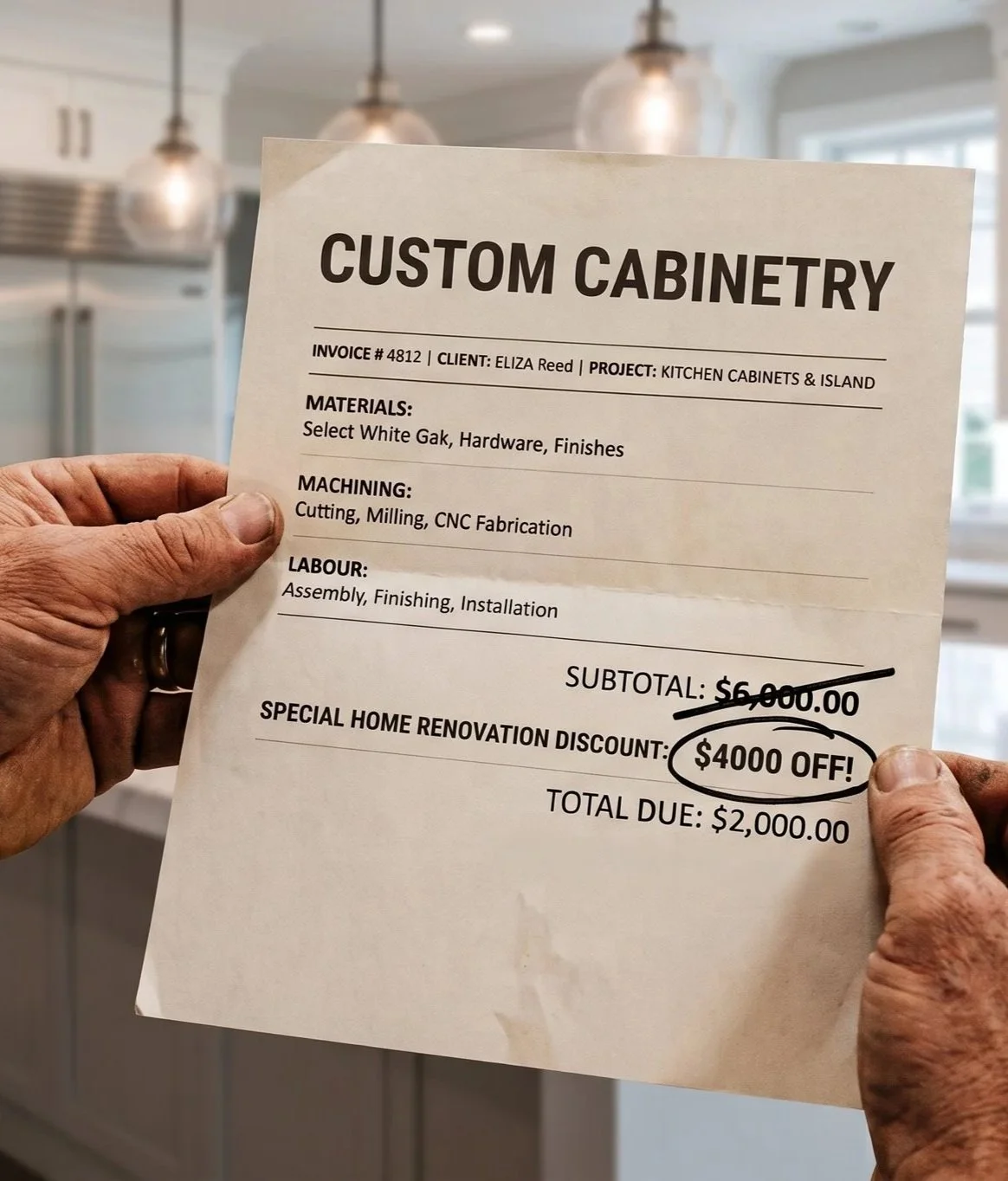
The quote is one number, or close to it. If material, machining, and labour aren’t separated, you’re looking at a retail price, not a cabinetry price. A workshop that cuts board can tell you what the board costs. A showroom is structured not to. A lot of businesses will provide a single quote for convenience and simplicity. That's fine. The issue comes after you ask for a breakdown, if they refuse, then you can be pretty sure you’re paying for stuff you don’t need.
The specification is thin. Big renders, vague materials. If the visualisation is more detailed than the substrate spec (i.e. if they tell you the exact shade of the handle but not whether the carcass is 18mm thick or moisture-resistant) the money is going into presentation, not product.
The discount is large and sudden. A price with a lot of give in it had a lot of margin in it to begin with. Genuine cabinetry pricing is fairly tight, because board and hardware cost what they cost. Big discounts are a sign of dishonesty, even if they feel good in the moment.
What you’re actually buying, and what you might not need
Here’s the useful reframe. Strip a big-box custom job down and there are really only two things you’re paying for: cabinets cut to your dimensions, and the skilled labour to fit them. Everything else in the stack — the showroom, the sales process, the design theatre, the layers of margin — is not substance.
For a genuinely complex job, some of that delivery earns its keep. A large kitchen with stone benchtops, integrated appliances and plumbing all landing on the same day is a coordination problem, and paying one organisation to own it can be worth every dollar. You’re buying good communication and a single organisation to contact if it goes wrong.
But a great many jobs aren’t that. Wardrobes, laundries, a run of kitchen carcasses, an office fit-out, garage storage, a vanity: these are cabinetry, not orchestration. And for those, most of the big-box number is buying you services you really don’t need.
The split most people don’t know exists
There’s a middle path that big-box pricing hopes you won’t find. You have the panels CNC-cut and edge-banded to your exact dimensions, then you assemble them yourself over the weekend.
What that does to the stack is dramatic. The cabinets still cost what cabinets cost, made on the same kind of machinery to the same tolerances. But the showroom, the commission, and the layered install margin disappear, because you’re buying the product from the people who make it and the labour from the people who do it, with nobody in between charging for the introduction.
For the confident DIYer, the savings are massive. Panels that arrive cut square, edge-banded and labelled go together with a drill and a spare weekend for a wardrobe, a laundry, or a desk. You’re paying for the one part of the job that needs a CNC machine, and doing the rest yourself.
How to know, before you sign
You don’t have to guess whether a big-box quote is heavy. You can find out in one conversation. Ask for the number broken into materials, machining, and labour. Ask what the board and edging actually are. Ask who does the install and whether they’re a sub-contractor. Ask what comes off if you supply your own measurements, or arrange your own fitting.
A quote built on real cabinetry costs survives all four questions easily. A quote built on a margin stack starts to get uncomfortable and that discomfort is the answer. The more the total resists being itemised, the more it was never about your cabinets.
Custom doesn’t have to mean marked-up. It’s made to your dimensions and should be made to your budget too. Get the specification and the fit right and you’ll have cabinetry that lasts fifteen years, for a price that reflects what it’s made of, not where it was sold.
Weighing up a big-box quote
against the alternatives?
See what’s possible with Cutshop®’s bespoke cabinetry. Kitchens, laundries, vanities, wardrobes, offices, garage storage and custom furniture, cut to your exact dimensions with no minimum order. Send a sketch, a cutlist or a DXF file for a quote, bring your measurements into a branch, or call 0800 CUTSHOP.
