
Edge-Finished vs Raw-Cut Panels
The Small Detail That Determines How Long Your Cabinetry Lasts
Every cabinetry decision people enjoy making is about surfaces. The colour of the doors. Whether the handles are brushed or black. Whether the whole thing reads warm or cool against the floor. Nobody has ever stood in a showroom and thought carefully about the two millimetres at the front of a shelf.
Which is unfortunate, because that is the part that fails first.
Cabinetry almost never perishes from the middle out. It goes at the edges: the chipped corner on a drawer front, the shelf gone soft and swollen where a damp towel sat. The panel itself is usually fine. The edge is what gave up.
Here’s what is actually happening in those couple of millimetres, and how to make sure you’re buying the version that lasts.
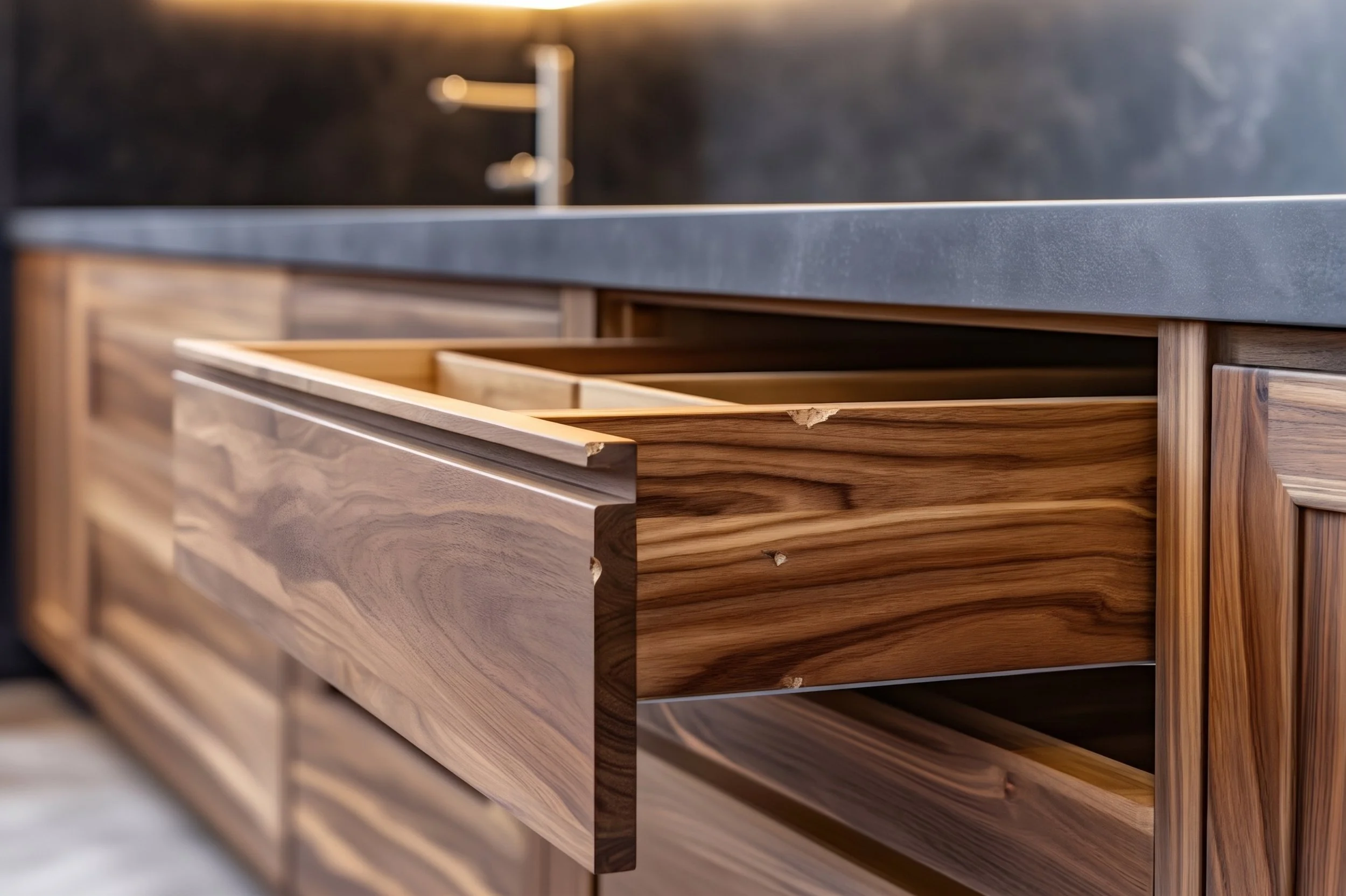
A melamine panel is sealed on two sides out of six
Start with what the board actually is.
A standard cabinetry panel (18mm melamine-faced chipboard or MDF, the material most New Zealand carcasses are built from) is a compressed wood core with a hard decorative surface pressed onto the front and the back. That pressed face is tough. It resists scratching, it wipes clean, and it doesn’t care about the occasional splash.
The four cut edges have none of that. They are open core: wood fibre and resin. Left raw, they’re the only part of the panel that behaves like bare timber, and in some ways worse than timber, because chipboard and MDF are engineered to be flat and stable, not to be waterproof.
Edge-finishing is the step that closes those four sides. A strip of banding is glued to the cut edge, trimmed flush and buffed, and the panel goes from sealed on two sides to sealed on all six.
That’s the entire difference. It sounds like a small detail, but it’s the difference between cabinetry that is still square and tight in fifteen years and cabinetry that starts falling apart after a couple
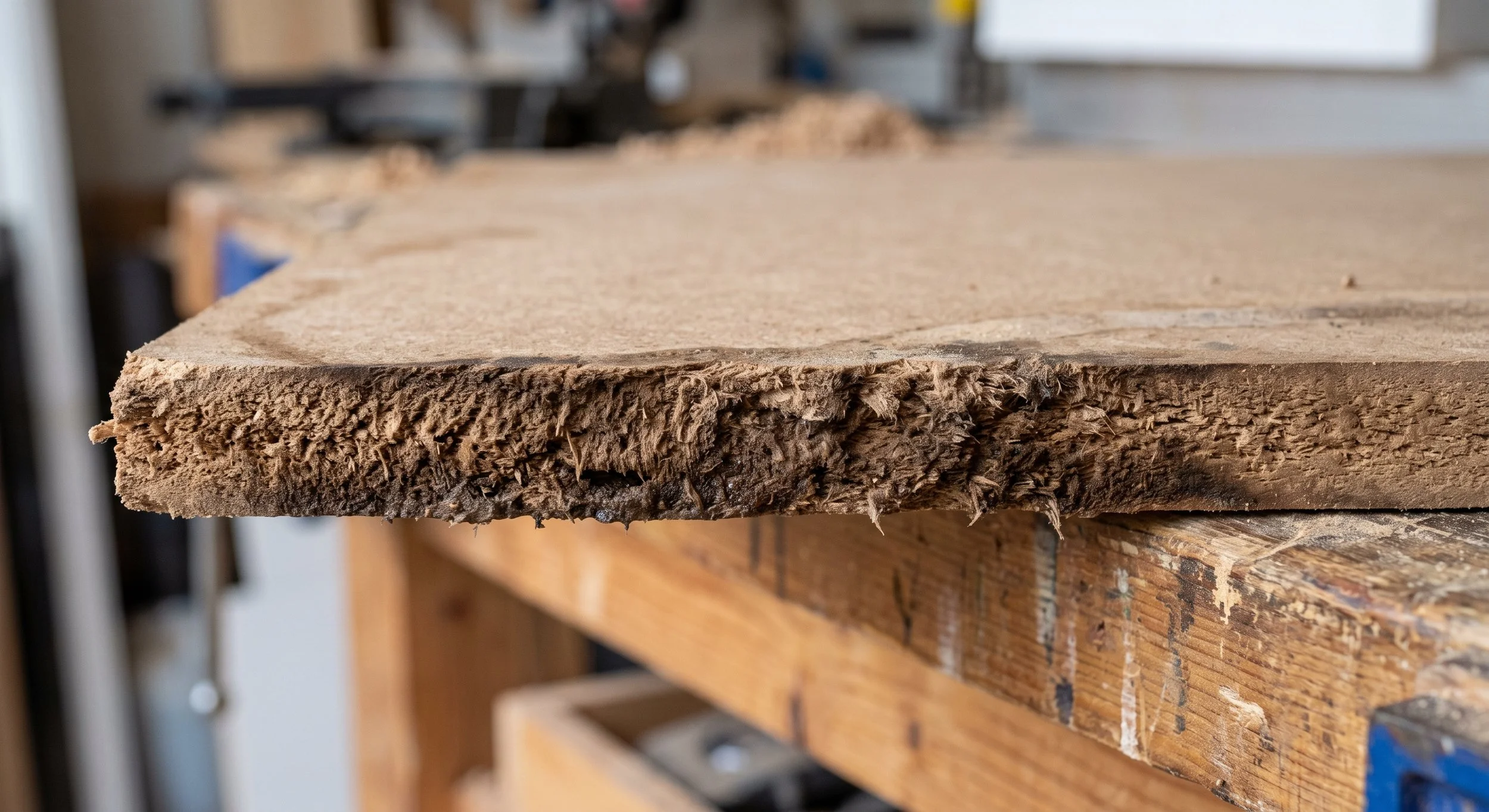
What happens to raw edges over time?
They take on moisture.
This is the big one. An unsealed MDF or chipboard edge behaves like a sponge. All it takes is a bit of condensation or a leaky tap. The core swells permanently. The fibres were compressed under enormous pressure at the mill; once they draw in water and expand, they do not go back. You end up with a spongy, oversized edge that no longer fits the cabinet it belongs to.
They absorb everything you clean them with.
Raw core is porous. Hands, dust, cooking grease, spray cleaner, it all soaks in rather than wiping off, so a raw edge slowly gets stained. You can’t clean it back, because the mark isn’t on it, it’s in it.
They chip.
A finished edge is a hard band that can take a decent knock. A raw edge is the softest part of the whole panel, and it’s always the part sticking out into the room. Vacuum cleaners, chair backs, kids’ running about, a laundry basket swung around a corner. Each one takes a small chip out of the corner and they drastically compound over time.
They never quite look finished.
Even when everything else is right, an open edge reads as unfinished joinery, and painting it doesn’t fix it. Paint sinks into the core, and leaves you with the same issues as moisture soaking in.
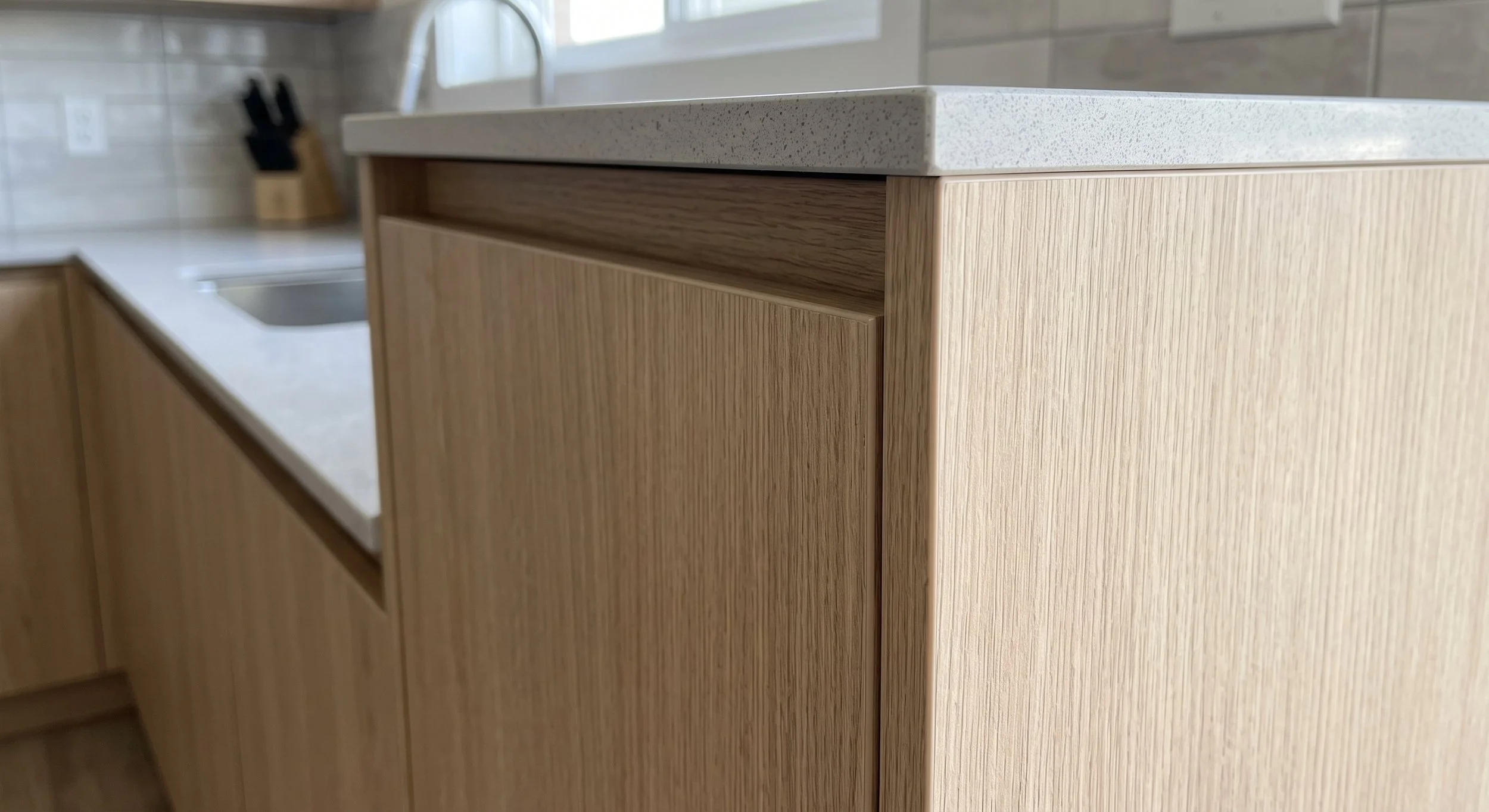
Not all edging is the same
“Edged” isn’t really a specification. There’s a real range, and the differences show up in the places you touch most.
0.4mm melamine or paper tape
The thin stuff, often iron-on. It seals the edge and it’s inexpensive, which makes it perfectly reasonable on internal shelving or a garage cabinet. But there’s almost no material there to absorb a knock, so it chips at the corners and, once a corner lifts, the rest peels back.
2mm ABS, usually with a small radius
Worth specifying anywhere that gets handled often: door and drawer fronts, the front edge of open shelving, anything at hip height in a kitchen, and anything in a rental property. The extra millimetre gives the machine enough material to round the corner slightly, and a rounded edge sheds impacts that a square one takes on the chin.
1mm ABS
The workhorse, and the sensible default for carcasses and shelving throughout a house. Machine-applied, properly bonded, trimmed flush. It’s thick enough to behave like an actual edge rather than a coating, and it stays looking like one.
Laser or zero-joint edging
The premium option, where the banding is fused without a visible glue line. Mostly an appearance decision on high-end fronts, though no glue line also means no thin seam for moisture to find.
Two more things worth knowing: ABS and PVC both perform well; ABS is halogen-free, which is why most New Zealand specifications now default to it. And the adhesive matters as much as the band. Standard EVA hot-melt is fine for general work, while PUR adhesive holds up better against heat and moisture, which is the argument for using it around dishwashers, ovens and laundry tubs.
The question that changes your quote: Which edges get banded?
Here’s where two quotes for “edge-banded cabinetry” can mean genuinely different things. Some price the visible fronts only. Some band all four edges of every panel. The gap between those two approaches is real money, and it’s invisible unless you ask.
Band these, always
Every edge you can see. Every edge you touch. All four edges of every door and drawer front, not just the top and sides: the bottom edge of a door is the one closest to spills and mop water, and it’s the one people often forget to protect. The front edge of every shelf, because that edge carries weight, gets touched often and holds the entire visual impression of the cabinet.
Band these too, even though they’re hidden
Anything in a wet or humid room. In a laundry, a bathroom, a vanity or the cabinet under the kitchen sink, band all four edges of every panel including shelf backs and internal verticals, and specify a moisture-resistant substrate while you’re at it. Water doesn’t only arrive from the front.
The same goes for any edge sitting against an exterior or south-facing wall in an older New Zealand home. Those walls are rarely flat, which means there’s an air gap behind the cabinet, and that gap gets colder and damper than the room does.
Where raw edges are fine to keep
An edge that’s captured inside a glued joint is sealed by the joint. A back panel housed in a groove is enclosed on all sides. A filler or scribe cut on site and covered by a face panel doesn’t need banding either. Leaving those raw is normal practice and it saves you money without costing you anything.
This isn’t about having no raw edges. It’s about knowing which of your edges are ok to keep raw and which need edgebanding.
Why this is a decision you only have one chance to make
Some cabinetry mistakes can be corrected later, albeit expensively. This one basically can’t be corrected if you make the wrong choice initially.
Banding is applied to a loose panel on a machine that glues, presses and trims the band flush in one pass. Once panels are assembled into a carcass and fixed to a wall, most of those edges are no longer reachable, and the ones that are will never take a band cleanly because you can’t get the pressure or the trim.
A household iron and a roll of tape will get you there on a garage shelf, and there’s no shame in that. But hand-applied tape sits slightly proud of the surface, which means you can catch a fingernail on it, and that’s exactly how it starts lifting. A machine-trimmed edge is flush, so there’s nothing to catch.
That’s the real reason to settle it at quote stage rather than at install: edge-finishing is the one part of a cabinetry job you cannot retrofit. And relative to the cost of the panels, it’s small. The banding across a whole cabinet's worth of components costs a fraction of what it would to replace a swollen cabinet in two years’ time.
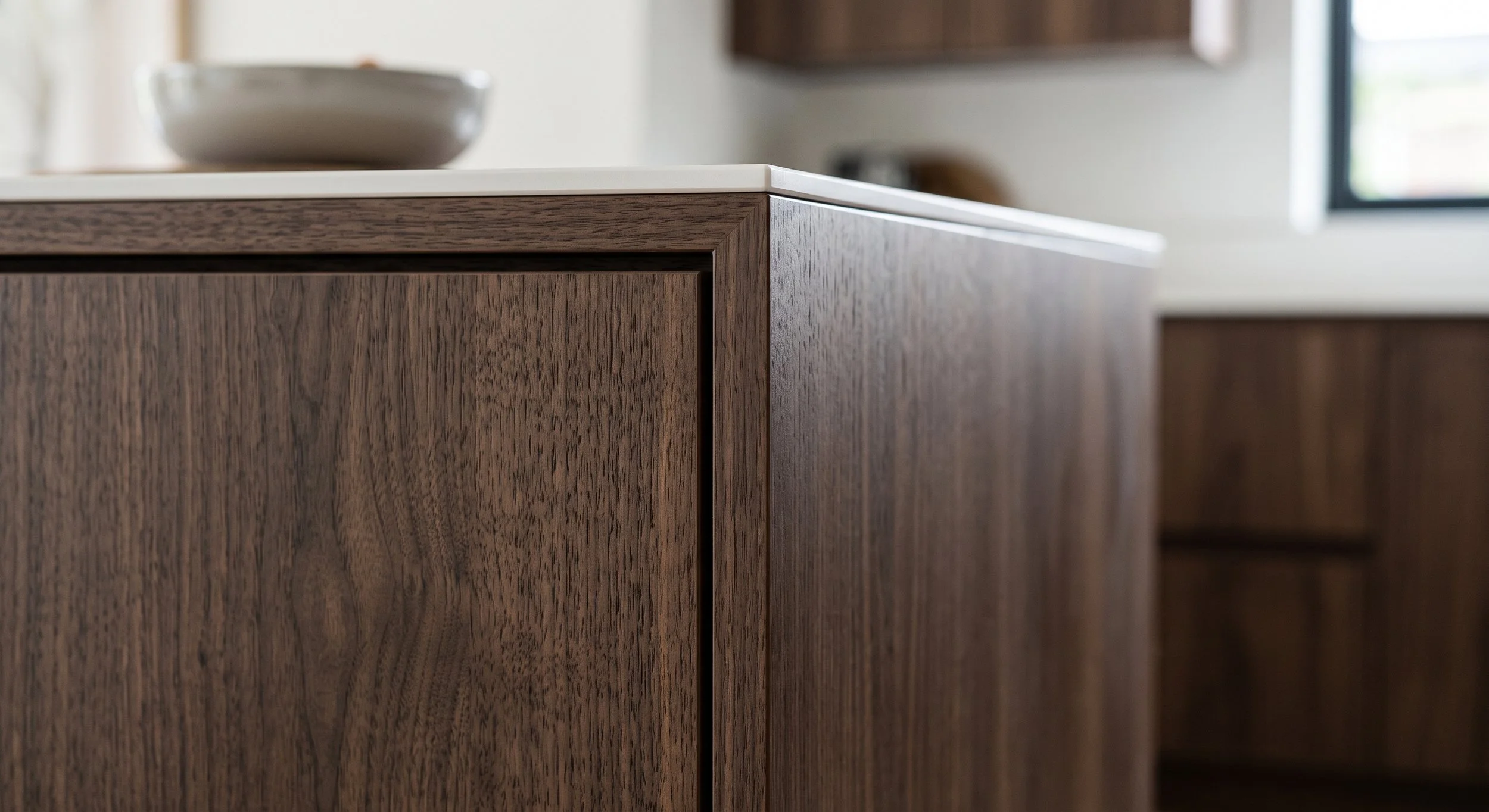
How to specify it, in one line
You don’t need to become an expert. All you need is one sentence in an email:
“All panels edge-banded in 1mm ABS to match the board, 2mm on all door and drawer fronts, and all four edges banded on everything in the laundry and vanity, on a moisture-resistant substrate.”
Anyone quoting properly will read that and price it without blinking. If a quote comes back that can’t tell you which edges are banded and what type of edging is being done, then you’ve learned something useful about your choice of manufacturer too. If that happens, come to Cutshop® instead.
Cabinetry is chosen because of how its surfaces look, but falls apart at its edges. Get the two millimetres right at the start, when the panels are still flat, still loose, and still on a machine that can do it properly. This simple step will buy yourself a decade of not thinking about it.
Want your panels cut and finished
properly the first time?
See what’s possible with Cutshop®’s bespoke cabinetry — kitchens, laundries, vanities, wardrobes, offices, garage storage and custom furniture, CNC-cut to your exact dimensions and professionally edge-banded before they reach you, with no minimum order. Send a sketch, a cutlist or a DXF file for a quote, bring your measurements into a branch, or call 0800 CUTSHOP.
